
All health or fitness goals, even life goals..
Require proper sleep.
You need good quality and quantity sleep, period.
There are immediate dangers like car accidents, workplace injuries and death.
While they also contribute to chronic illness like heart disease, diabetes, obesity and depression.
On the flip side, quality sleep helps with mental clarity and focus, losing body fat and building muscle…
Any physical or mental issues you’re having, sleep is the first place to start healing.
Let’s dive into some science and solutions to understand sleep..
And to help you sleep like an adult to achieve those goals.
5 Misconceptions About Sleep
These misconceptions are from the bookshelf at NIH ( https://www.ncbi.nlm.nih.gov/books/NBK20359/ )
Misconception #1 - Sleep is when the body and brain “shut down”
As you’ll read in my explanation of ‘biology of sleep’ below..
Your brain, endocrine (hormonal) system, and body repair are hard at work while you sleep.
Misconception #2 - Just one hour less sleep won’t make that much difference
Though you FEEL perfectly fine..
Just one hour less sleep than you need, can create a ‘sleep debt’ that accumulates..
And can have negative performance, mental and emotional effects.
Misconception #3 - The body can quickly adjust to different sleep schedules
Your body has a ‘biological clock’ that signals sleep and wake cycles.
Cognitive and motor skills (walking, hand-eye coordination, driving, etc..) decrease..
When you drastically change sleep cycles (e.g. shift work or business trip to different time zone)
We’ll look at some solutions to these below.
Misconception #4 - People need less sleep as they get older-
False. They might get less sleep because of medical conditions, being easily disturbed, or are in more pain.
Children and teens need more sleep as their bodies grow, but adults need 7-8 hours.
Misconception #5 - A good night’s sleep can cure excessive daytime sleepiness.
Even with plenty of hours of sleep, sleep disorders can cause daytime sleepiness.
Disorders like sleep apnea, insomnia, and narcolepsy. A deep dive into these is for another post.
How Sleep Works
Circadian Clock
Most people know it as the circadian rhythm and ‘circadian’ simply means ‘about one day’
There are two general ways your body knows when to sleep and wake up:
1. External or Environmental signal (light/darkness)
2. Internal or Biological signal (like core body temperature)
Without the external signal, your body’s circadian rhythm is a little over 24 hours.
The image below shows an example of this.
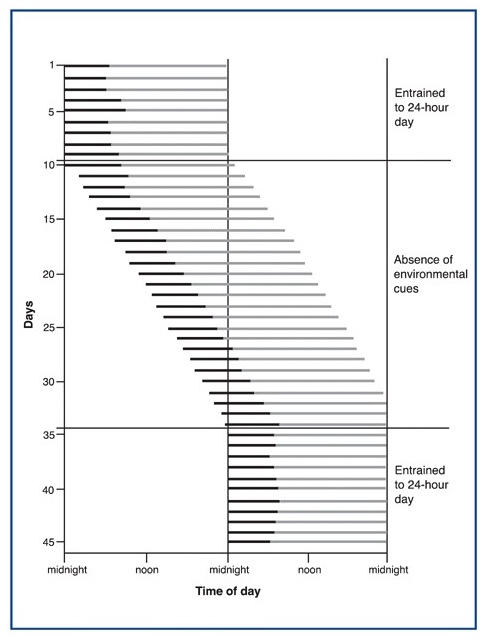
Days 1-10, the subject was exposed to sunlight so their sleep cycle was 24-hours.
Days 10-35, the subject was kept in the dark, so their sleep cycle extended past 24-hours.
Days 35-45, the subject was reintroduced to sunlight and their sleep cycle returned to 24-hours.The Biology of Sleep (A little science)
Light
So how exactly does your body learn to follow the external signal, light?
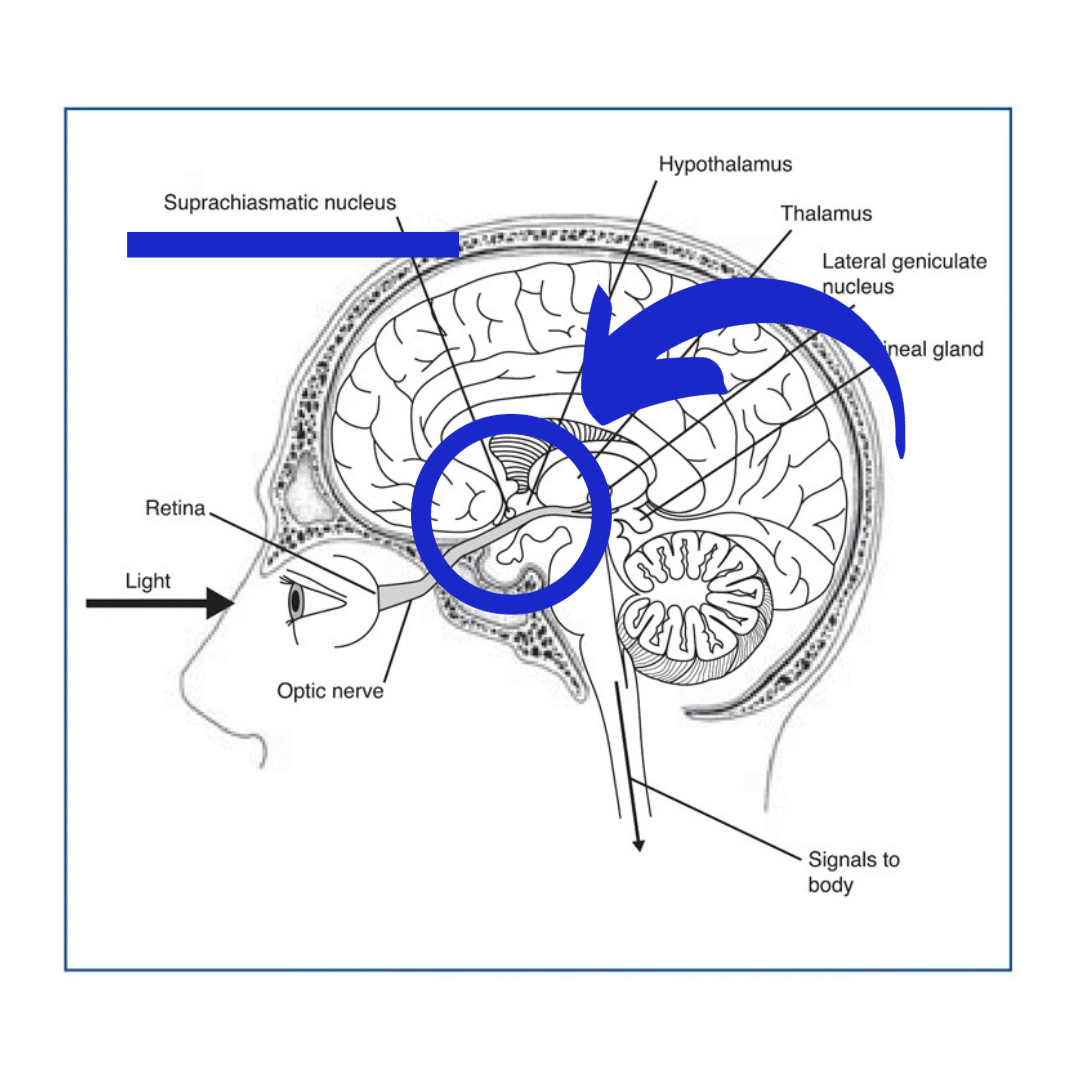
1. Photoreceptors in the retina (layer at the back of your eyeballs) transmit the signal they get from light, to the brain.
Specifically, the suprachiasmatic nucleus (SCN) located in the hypothalamus.
2. The SCN signals the pineal gland to increase or decrease melatonin production.
(Melatonin is known as the sleep hormone)
Brain Chemical
Another way your body signals sleep cycle, adenosine.
Adenosine is a chemical that builds up in your brain, the longer you’re awake and makes you feel sleepy or drowsy.
As you’ll find in the solutions section below..
Artificial bright lights can trick your brain and disrupt your sleep cycle.
Caffeine binds to the same receptors as adenosine..
So adenosine can’t signal the brain that you need more sleep.
NREM & REM Sleep
NREM - Non Rapid Eye Movement sleep
There are 4 stages of NREM sleep
Stage 1 - Very light sleep
- Muscles relax, heartbeat/ breathing/ eye movements slow down
- Brainwaves begin to slow down
Stage 2 - Light sleep
- Muscles relax, heartbeat & breathing slow down further than stage 1
- Body temperature drops and eye movement stops
- Brainwaves slow down further
Stage 3 - Deep sleep
- *This stage is needed to feel refreshed in the morning
- Heartbeat and breathing slows to lowest level
- Happens in the first half of the night
- Brainwaves slow down further
Stage 4 - Deep sleep
- Extremely hard to be awakened
- All other functions are same as stage 3
REM - Rapid Eye Movement Sleep
Your eyes move side to side or up and down at times.
Some scientists believe the eye movements relate to visual images of dreams.
Many bodily functions seem to be similar to waking levels
- Breathing becomes faster and irregular
- Heart rate and blood pressure increases
BUT, your arms, legs, basically the muscles that move your body go limp..
So you don’t act out your dreams.
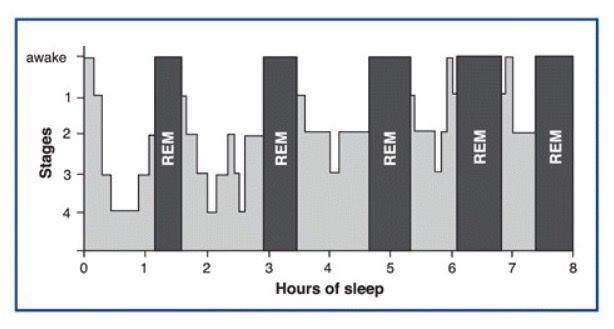
(*The light gray area on the photo above are NREM cycles)
Each sleep cycle of NREM and REM are about 90-110 minutes.
NREM decreases as REM increases throughout the night.
Function of Sleep
Below are hypothesized functions of sleep:
- Restoration and recovery - replenish energy stores and repair happens
- Energy conservation - metabolic rate slows during sleep
- Fight off infections
- Memory consolidation - reinforce learning and memory while clearing unneeded memories
- Brain development - REM sleep is prolonged during fetal and infant development showing the brain continues to develop into adulthood
- Discharge emotions - scientist speculate dreaming provides a safe discharge of emotions
Sleep’s Effect on Weight Loss and Muscle Gain
Weight Loss
The two most focused areas for weight loss are exercise and diet.
But quality & quantity sleep is the factor you need for long term results.
This is a summary of what they found in this study (Sleep Deprivation: Effects on Weight Loss and Weight Loss Maintenance Silano et al., 2022)
Poor sleep, both quantity and quality, lead to an increase in energy intake, mainly from snacking..
Especially foods rich in fat and carbohydrates.
Continuous sleep restriction (less than 6 hours of sleep) has been associated with increased risk of obesity and diabetes (Knutson & Cauter, 2015)
Some explanations are:
- Impaired glucose metabolism - ability to absorb and use glucose
- Reduced insulin release & sensitivity - hormone used to absorb glucose
- Increased cortisol levels - stress hormone
- Higher hemoglobin A1c levels - measure of glycemic control
- Ghrelin increased while Leptin decreased (Ghrelin makes you hungry, Leptin says you’re full)
Some indirect effects of sleep loss, preventing weight loss could be:
- Poor emotional control leading to bad food choices
- Less desire to exercise from being tired
- Less desire to move in general
- More stress, leading to ‘stress eating’
- Consuming more stimulants/caffeine to stay awake.. Leading to poor sleep again
Muscle Gain
Most people only focus on exercise to gain muscle.
Then they wise up to protein and supplements..
But sleep is the last thing on their minds.
Skeletal muscle is one of the largest organs and most abundant tissue in the body (45% of total body mass) and the gene are expressed in a circadian pattern
“When circadian rhythms are disrupted, the observed effects on skeletal muscle include fiber-type shifts, altered sarcomeric structure, reduced mitochondrial respiration, and impaired muscle function.” (Harfmann et al., 2015)
“Even relatively short periods of sleep restriction (less than a week) can compromise glucose metabolism, reduce insulin sensitivity, and impair muscle function” (Bescos et al., 2018; Buxton et al., 2010)
These studies are looking at BASIC muscle maintenance and function.
Poor sleep makes it harder to maintain muscle, let alone gain muscle.
A study (Lamon et al., 2021) conducted to see the effect of acute (30 hours) sleep deprivation on muscle protein synthesis found:
- A decrease in muscle protein synthesis for men and women
- A 24% reduction in testosterone for men
- Cortisol was 21% higher in the sleep deprived condition
If you’re hustling to build muscle with intense exercise, plenty of protein and recovery..
You’re trying to fill up a bucket with holes, without proper sleep
The Solution: How to Get Better Sleep
They call it ‘Getting ready to sleep’ for a reason
You’ve probably experienced this..
- No thoughts but no sleep, eyes wide open staring at the ceiling
- Thoughts racing while you’re laying there shifting around
- Fall asleep only to wake up in the middle of the night
Here’s the the basic 5 step sleep protocol
Step 1: Sunlight
Remember your circadian rhythm is set with the external signal of light
As soon as the sun rises, get some sunlight on your body and in your eyes.
*Disclaimer: Don’t look directly into the sun, just in the direction of the sun.
This works best if you don’t have sunglasses, glasses, contacts or any glass in the way.
You don’t need to get sunlight in your eyes when you’re in the sun throughout the day.
But, get some more sunlight into your eyes as the sun is setting.
Step 2: Early Dinner
Finish dinner 3-4 hours before bedtime.
You want food to empty from your stomach and have your blood sugar back to normal.
If your circadian rhythm is synced up with the sun, bedtime would be around 9-10pm..
So dinner should be around 6-7pm.
If you frequently wake up to pee in the middle of the night..
Sip on your water at night or stop drinking 1-2 hours before bed.
Step 3: Bedroom Setting
Temperature
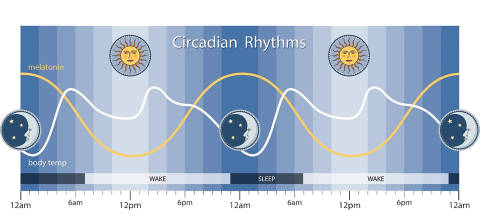
A cool room temperature is preferred to help lower your body’s core temperature.
As you see in the chart, your body’s core temperature drops during sleep.
65 degrees fahrenheit seems to be the average optimal temperature but test it out to find what works best for you.
Light
Avoid bright lights after the sun sets.
Blue light from phone screens, tablets, computers and tv can disrupt melatonin production, the ‘sleep hormone’.
Black out your room if possible
- No electronics
- No light leaking in through your windows
- No tv, computer, or phone screen light
- No night light (sorry)
Noise
Avoid all noise in your bedroom.
I took the batteries out of my clock because the ticking would keep me up.
Earplugs and eye masks were shown to help get better, undisturbed, quality sleep.
Just be careful of pushing earwax into your ears with those earplugs.
Step 4: Sleep Disruptors
Caffeine
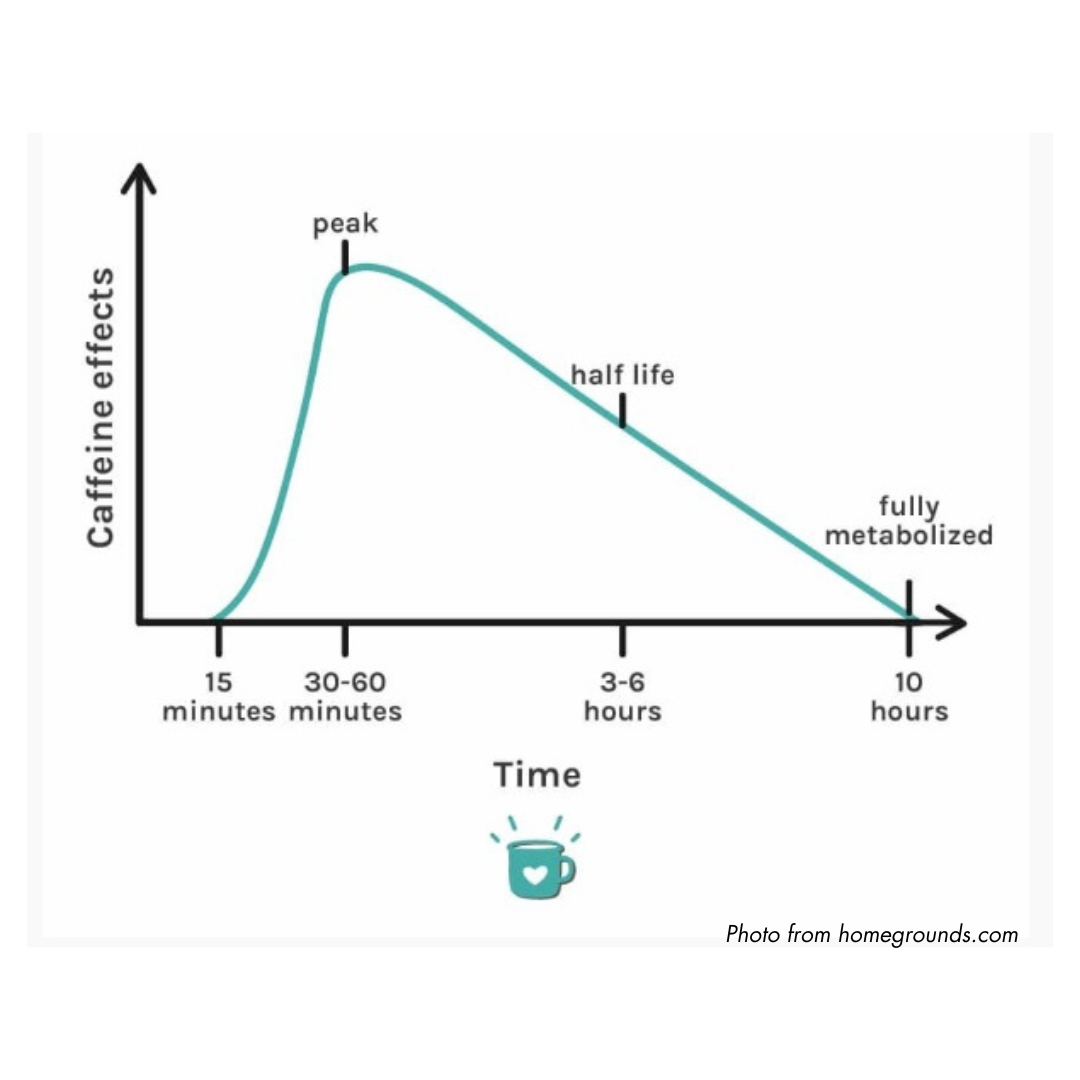
For most people, caffeine disrupts sleep.
It takes about 6 hours for half of the caffeine to be removed from your body.
Then at about 10 hours, caffeine is completely metabolized.
Schedule your last cup of coffee 8-10 hours before bedtime.
Alcohol
It can disrupt your sleep in several ways:
- The first half of the night, it increases deep sleep while lowering REM sleep
- While the second half, you don’t get enough deep sleep so you wake up frequently
- Your melatonin levels drop, further disrupting sleep
- It’s a muscle relaxant that can lead to blocked airway, snoring, and sleep apnea
- It’s a diuretic, which can make you wake up frequently to use the restroom
*If you are a heavy drinker, speak to a physician to cut out alcohol.
CBD and THC (Cannabis) (Kaul et al., 2021)
- Short term THC use
- it helps you fall asleep
- Increased total sleep time
- Less middle of the night waking
- Decreased REM sleep
- Long term THC use
- takes longer to fall asleep
- Decreased total sleep time
- More sleep disruption
- Decreased REM sleep
CBD seems to affect different people differently..
With some having trouble falling asleep to others getting better sleep from it.
There are more studies being conducted on the effect of THC and CBD on sleep.
*CBD is a compound found in marijuana but it doesn’t have the psychoactive effect of THC
(*Disclaimer: this is not medical advice. Speak to your physician before consuming or making changes)
Step 5: Shift work Solution
The world is awake 24/7 so some jobs spill into the night or are overnight shifts.
I’ll be honest.. this is a tough one..
As your health and fitness coach, I want what’s best for your health.
If you have a job with this schedule, I’d hope it’s temporary.. especially as you get older.
Here are some tips for shift workers
1. Follow a consistent schedule as much as possible
- If you have a choice, choose consecutive overnight shift days, back to back
- Caffeine intake should follow the recommendation above, stop consuming it 8-10 hours before bedtime
2. Use the ‘sunlight effect’
- Expose yourself to bright light when you wake up, even if it’s artificial
- Have less light exposure and dim lights towards your bedtime
- Follow the same protocol for ‘bedroom setting’ above
3. Perfect health habits
If your sleep is compromised, the best thing you can do is to perfect your other health habits.
- Nutrition
- Hydration
- Movement
- Exercise
- Stress management
*Refer to the other journals for details on these habits.
I’ll leave you with this.
Remember, this is sleep 101
We can get granular but the simple explanation is..
If you use your mind and body productively during the day.
Your mind and body will need rest and you’ll sleep just fine.
Be thankful for another day you’ve lived and do your best tomorrow.
Good night.
Daniel