
You hear experts say “You don’t need motivation, you need discipline!”
They assume motivation means an outside source giving you energy or desire to take action.
They’re not entirely wrong but what they mean to say is ‘inspiration’
Your Understanding of Motivation is Slowing Down Your Success..
Success in for:
- a strong lean body
- achieving financial freedom
- focus to pursue your passion
- energy to be productive all day
- that next big change in your life
Inspire (in the word inspiration) traces back to the latin word ‘inspirare’ meaning (“to breath or blow into”)
Religious context says it means “to breathe life into”
You’ve experienced this when the hero is giving a speech before chaos on the battlefield
- You’re deeply moved
- You believe in their cause
- You’re ready to jump into the screen and fight for freedom
- “Are you not entertained!”
It makes you feel energized, passion for the cause, and excitement to take action.
This is exactly what the experts are saying to avoid.
The fleeting feeling or emotion you get when you watch motivational videos, quotes or stories.
What you are looking for is the desire to take action created by you
So let’s take a look at what motivation actually means…
And the type of motivation that will encourage persistent action.
What is Motivation?
Motivation is derived from the latin word ‘motivus’ meaning 'a moving cause' (a cause to move or take action)
There are primary or basic motives in animals or humans..
Think natural instincts..
They include hunger, thirst, sex, avoidance of pain, aggression or fear
- When you get hungry, you have motive to get food
- (hunger is the motivation)
- When you want sex, to reproduce, you have motive to find a mate through resources, attractiveness, and status
- (sex, on a primal level, is the motivation)
- If you have fear, your motive is to protect yourself
- (fear is the motivation)
If we were just like animals, that’s as far as we’d get..
But the secondary motives are what we’re focusing on today.
These are psychosocial motivators in humans, which are learned motives.
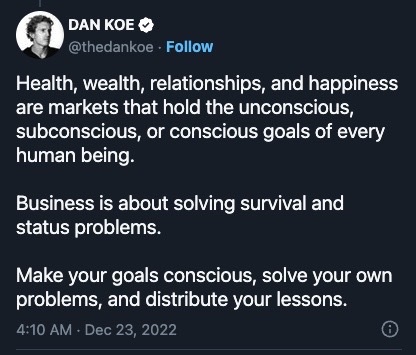
The general categories are health, wealth, relationship, and happiness..
'It’s a mixture of primal needs, socially learned wants, and deep individual desires.'
Interesting side note..
These are considered the four eternal markets because most businesses are from these categories.
Dan Koe shares how to understand and solve these problems in your life..
As a way to market your solutions to a group of people like you.
You’re not achieving success, NOT because you don’t know what motivation means…
But because you don’t know where your motivation is coming from..
The Self-Determination Theory helps explain this.
Extrinsic Motivation is at the Root of Failure
“Self-determination (SDT) is a theory of motivation." -helpfulprofessor.com
Self-determination is the sense that we
- are in control of our own lives and choices,
- are motivated, and
- can meet our potential.
A. This Self-determination theory created by (Richard M. Ryan and Edward L. Deci 2000)
starts with two basic assumptions about humans:
- Human beings strive for growth and they
- Are capable and need internal source of motivation
People need to have the Basic Psychological Needs met to achieve growth..
And working from external to internal motivation helps meet those needs.
B. The Basic Psychological Needs Theory(BPNT) says humans have a psychological need for Autonomy, Competence, and Relatedness to achieve self-determination
- Autonomy - the need to feel in control of your own choices in life, the ability to influence your environment
- Competence - the need to have fundamental skills to complete tasks, to foster self-confidence and self-esteem
- Relatedness - the need to connect to other people, a sense of belonging to a community or group
If extrinsic motivation is at the root of failure, then the goal is to get closer to intrinsic motivation
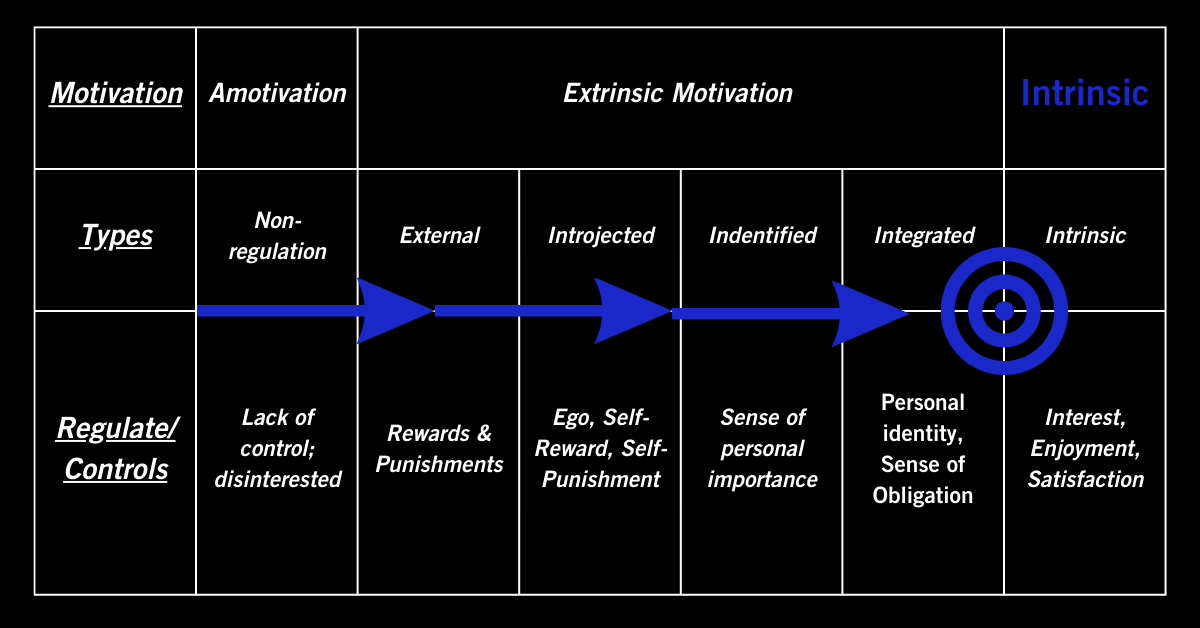
C. There are six stages or types of motivation that sit on a continuum

1- Amotivation (Non-regulation) - A complete lack of motivation
- Regulator - don’t value the activity
- don’t feel competent to do it
- assume they won’t get the desired outcome
This is how most people think about exercise and a healthy lifestyle.
Most don’t value it because they don’t understand the benefits..
And some people feel it’s too hard or time consuming so they won’t succeed even if they tried.
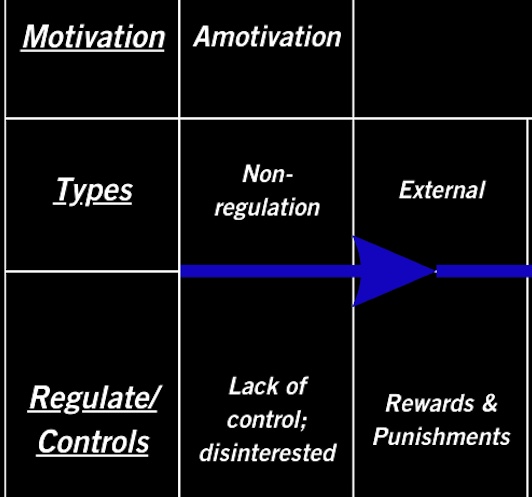
External, Introjected, and Identified are Extrinsic Motivation
Integrated and Intrinsic are Intrinsic Motivation
(I explain why Integrated is still in the extrinsic category, below)
2- External - take action to meet external demand or reward (from someone else)
- Regulator - controlled by outside consequences (reward or punishment)
- Simple behavior and consequence pattern used to train dogs or teach children
- Reward, remove reward, punishment, remove punishment
3- Introjected - take action to meet internal demand or reward (within the person)
- Regulator - controlled by their own feelings, want to feel worthy
- guilt, anxiety, ego, pride
- outside influence can also influence these feelings
4- Identified - take action because it’s viewed as personally important
- Regulator - it feels good to take action
Most people that start their fitness journey with external motivation will:
- Yo-yo diet (strict diet followed by burn out and back to old habits)
- Start and stop workout programs every couple months
- Get frustrated with slow results because they want that quick “result/ reward”
The motivations can range from:
- Look good for a wedding, special event, or vacation
- Impress a potential / current partner
- Feel better about themself, build self-confidence and self-esteem
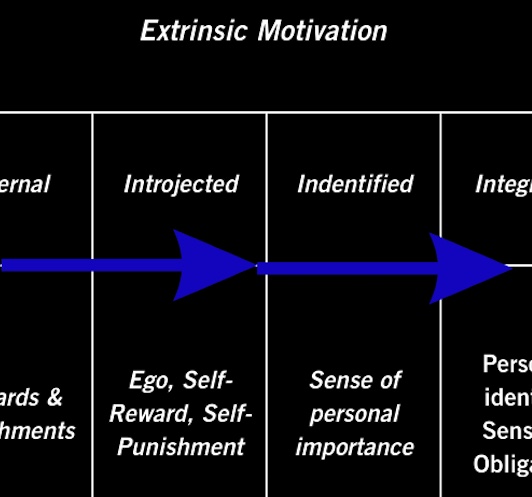
Even though ‘Identified Motivation’ is extrinsic..
And you’re moving towards intrinsic because you’re associating the behavior with internal value..
A stressful day, low energy, or shift in emotion can zap that motivation.
The Answer for Continued Success - Intrinsic Motivation
5- Integrated - take action because you feel it’s as important as your deepest values and needs
Regulator - a sense of obligation, created by you
You make it a part of your identity (which is why you achieve your goals when you make it a part of your identity)
Only reason this is considered extrinsic motivation.. Because it’s a means to an end.. There’s an outcome you want get from this
6- Intrinsic - fully autonomous and self motivated
Regulator - Interest in the activity
Enjoyment and satisfaction from taking action
Don’t need an outcome or result to motivate the behavior
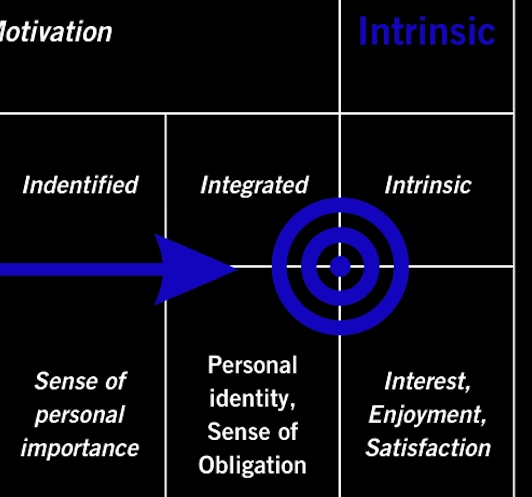
In our example of exercise and healthy habits, the people that operate in this stage of motivation either:
Naturally have athletic genetics, so they enjoy exercise or sports
Have made this a career so they want to look the part and practice what they preach
Decided to make a lifestyle change from a health scare or they decided to make health a part of their identity
The last two (fitness career and lifestyle change) can be both Integrated and Intrinsic
fitness career - they enjoy exercise and healthy habits
But they also are sharing their expertise for financial gain
lifestyle change - the actions become a part of their lifestyle
But they also want to keep their body healthy
Let’s connect all this to the Basic Psychological Needs
- Autonomy, Competence, Relatedness
Autonomy - If your behaviors are only extrinsically motivated..
You won’t feel in control of your decisions and environment.
Competence - isn’t finishing tasks well so you don’t get punished or so you get rewarded..
Competence is fostering self-esteem and self-confidence..
As well as the skill to take action, regardless of external or internal rewards and punishment
Relatedness - genuine relatedness cannot form if your motivation is rooted in rewards and punishment
- You will behave in ways to get rewards or to avoid punishment from others
- You will behave in social settings to feed your pride/ego, or to avoid hurting your ego
Strong individuals with autonomy and competence can form strong groups and communities for relatedness.
Extrinsically motivated individuals build conditional relationships.
Here’s how you apply this knowledge of motivation to take action and change your behavior.
The Solution
The goal is to have motivation that sits between Integrated and Intrinsic.
Why not solely in Intrinsic motivation?
“..from the time of birth, children, in their healthiest states, are active, inquisitive, curious, and playful, even in the absence of specific rewards” (e.g., Harter, 1978).
If you’re a retired billionaire or a child you might get away with acting only from self interest and satisfaction..
But as an individual, you want to find ways to develop intrinsic motivation for your responsibilities and goals.
1. Clarify Your Values and Needs
Write down how much time you spend on which activities throughout the week.
These are the things you currently value or need.
If you don’t value something on your list, it’s time to make room for new goals.
2. Integrate Your Goals With Your Values and Needs
Let’s say you want to achieve a new goal regarding fitness, great.
You can’t throw this goal into the pot with your priorities in life and expect everything to remain the same.
Imagine the important things in your life as different colors of paint.
If you put the right balance of each color, you will create a beautiful new color.
But if you put too many different colors or the wrong balance..
You’ll end up with muddy junk, or a color that’s not pleasant to your eyes.
Your job is to find a new balance of this goal and your existing values to make a harmonious color.
- How much time can you realistically dedicate to each?
- How much energy does each demand daily?
- Are you spending too much time or energy on one that doesn’t need it?
3. Define Your Motivation Stage, then Progress
In our fitness example…
Beginners typically start on the far left motivation stages.
They don’t know much about what to do and how to do it, but they want the results.
Not knowing what and how to do it.. they lose motivation quickly.
Or when they want to lose weight or gain muscle quickly, it’s usually for a reward or to avoid punishment..
So the motivation runs dry soon after.
Understand what’s motivating you to achieve this goal.
Quickest Way to Intrinsic Motivation
To make this new goal one of your top priorities..
You make room for it in your life NO MATTER WHAT.
Here are some examples:
- “I will exercise 3 times per week no matter what day or time”
- “On Monday, Tuesday, Thursday at 5pm after work, I am going to the gym no matter what” (Whether it’s walk on the treadmill, lift some weights, or sit in the sauna)
- “I am turning off all electronics by 9:00pm so I can sleep better, no matter what”
- “I will add one new habit to my diet each week” (Drink 80 oz of water, eat at least 100g of protein, eat 2 servings of veggies, eat out only twice a week)
It’s not a matter of achieving a goal by this date..
It’s continuing the action until you reach your goal and beyond.
You'll Need Some Mental Jiu Jitsu for Intrinsic Motivation
When the new action or goal seems to get difficult, you reframe it in your mind.
Rather than “it’s getting hard, why am I even doing this?”
Say “I’m the type of person that can overcome challenges”
It can turn into “I’m the type of person who thrives in challenges”
Most people live their whole lives based on external motivators and unconsciously adopting identities.
When you clarify your identity and shift towards intrinsic motivation..
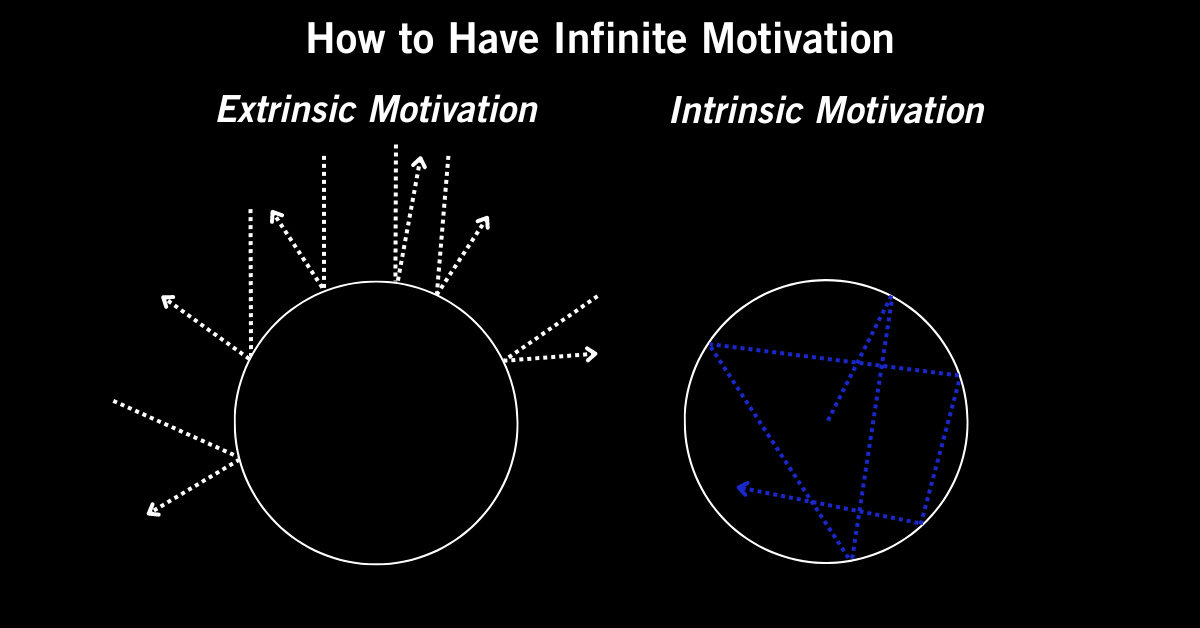
You can have infinite intrinsic motivation to succeed in your chosen identity.
-Daniel Ji
_______________________________________________________________
When you're ready, there are 3 ways I can help you:
1. Strategy Session - Instantly clarify your strategy for your exercise program, nutrition, or exercise technique. Book a call to get detailed answers to your immediate questions. Message me on twitter or instagram to schedule this call.
2. Free guide - I'm building two free guide. First, the most useful habits for your health and fitness goals in 6-weeks. Second, 'Zero-to-One' exercise guide to go safely from zero experience to learning the basics for any fitness goal. Message me if there's anything specific you'd like to learn in this free guide, on twitter or instagram.
3. Connect - simple questions, free content, considering coaching.. connect with me on twitter or instagram.